Articles

Professional Quality Management in the Oil & Petrochemical Industry

laptop icon - blog
pencil icon - blog page havosh.ir

What You Will Learn

Professional Quality Management in the Oil & Petrochemical Industry

In oil and petrochemical, availability alone is not sufficient. Call quality, clarity of emergency communications, and link stability must be measurable, recordable, and consistently reproducible.

This article demonstrates how quality assessment can be elevated from the level of “user or operator perception” to management-level, measurable, and auditable KPIs.

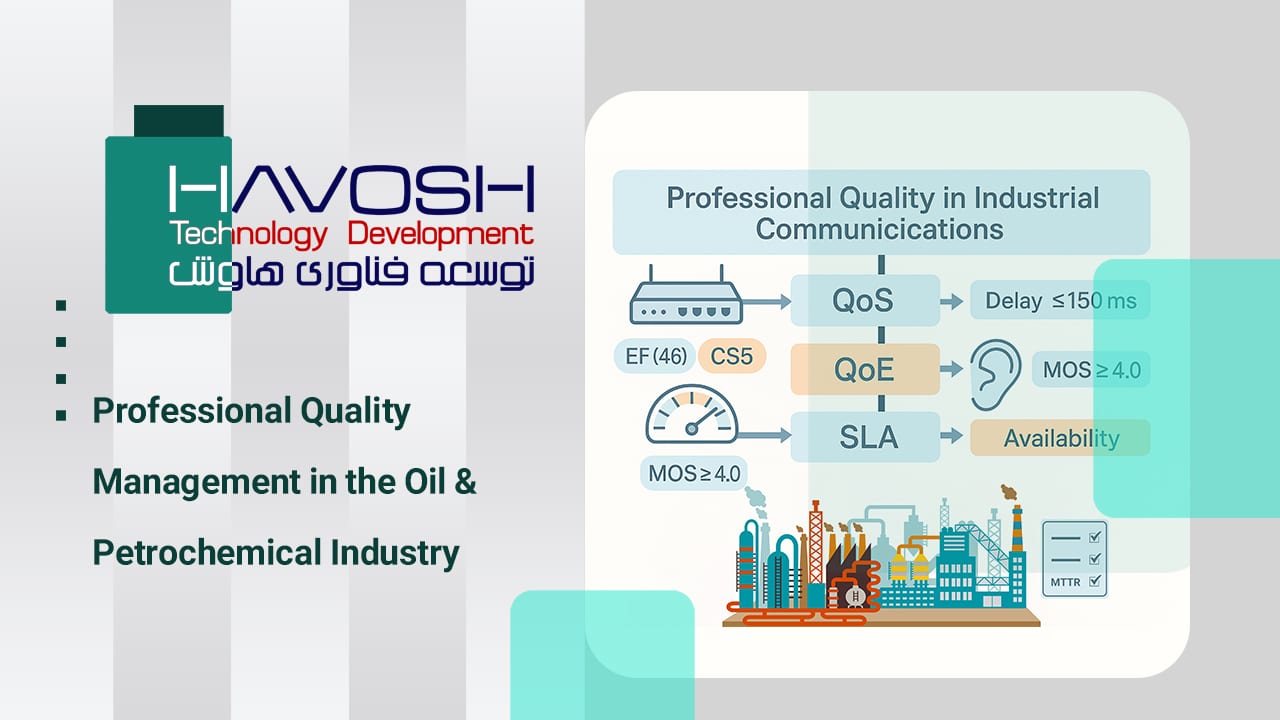
1. The Three Layers of Quality

1.1. Quality of Service (QoS) What occurs at the network level: delay, jitter, packet loss, and prioritization.

1.2. Quality of Experience (QoE) What the user or operator actually perceives: speech clarity, and momentary call drops.

1.3. Service Level Agreement (SLA) What is agreed upon between the operator and the contractor: availability percentage and incident resolution time.

Key Principle: If QoS is not properly defined, QoE becomes unpredictable, and the SLA cannot be effectively monitored.

2. QoS for Operational Communications

  • EF Class (DSCP = 46) for voice and emergency paging
  • CS5 for SIP / H.323 signaling
  • Traffic queuing and shaping across all hops (WAN, Core, Distribution, Access)
  • Call Admission Control (CAC) to prevent congestion in the EF class
  • Dedicated VLAN for Voice and Trust Boundary at the network edge

Result:
One-way delay ≤ 150 ms and low jitter, in accordance with ITU-T G.114

3. Quality in PAGA / ECS Is Different

In emergency paging systems, being loud is not enough the message must be intelligible.

Here, the STI / CIS is applied in based on with IEC 60268-16 standards. This means that we measure quality not based on "sound coming through", but on "percentage of message understanding". Periodic tests must be recorded.

4. QoE What the Shift Manager Actually Sees

Quality logs can be stored on the monitoring server or even on the SBC/IPPBX:

  • MOS and R-Factor
  • Delay, jitter, and packet loss
  • Call direction (inbound/outbound, PSTN, internal extension, radio gateway, etc.)
  • Problem location (LAN, WAN, telecom, user)

The monthly report becomes a quality document based not only on the operator's feelings but also on these indicators.

5. Professional SLA Design for Multi-Site Operations

In the oil, gas, and petrochemical industry, SLAs must be clearly segmented:

  • Communication SLA: for Core (OT/IT) around 99.5%
  • Service SLA: For VoIP/PAGA around 99% but with shorter RTO (Recovery Time Objective)
  • Emergency SLA: Alarm notification time ≤ 5 seconds in all areas

The SLA should specify:

  • What is being measured?
  • Where is it measured?
  • Who signs?

6. Testing (not just monitoring)

  • Daily short emergency paging test (silent or limited-zone activation)
  • Weekly VoIP call test to measure real latency
  • Monthly STI test for noisy areas )Speech Transmission Index(
  • Testing WAN outage scenarios and reviewing backup options

What is not tested will not work in a crisis.

7. The Role of Security in Quality

Attacks, scans, and excessive broadcasts degrade the speed of the EF (Expedited Forwarding) class, therefore:

  • ACL and user layer firewall are important for VoIP.
  • Separate operational VoIP from administrative VoIP
  • Monitoring of abnormal behavior (Anomaly) on SIP/RTP/SRTP ports

8. Output Required by Managers

Ultimately, the complex manager wants to see three numbers:

  • Percentage of calls with a desirable MOS of around 4 and above (Mean Opinion Score)
  • Percentage of PAGA messages with acceptable STI
  • Average time to resolve communication incidents (MTTR)

If these three numbers are reported monthly, the quality is "professional".

About Havosh

Havosh, with focus on VoIP, PAGA/ECS, operational call center and radio integration (DMR/TETRA) solutions, can write a quality plan (QoS/QoE Plan) for oil and petrochemical, implement EF/CS5 policy on routers and switches, test and document paging and emergency notification systems according to EN 50849 and IEC 60268-16, and finally deliver a monthly quality dashboard and SLA.

This way, instead of hearing "it was disconnected and reconnected" the employer will have a numerical report, citations, and ready to show to HSE and senior management.