Articles, Security

Secure and Resilient Communication Architecture in the Petrochemical Industry

laptop icon - blog
pencil icon - blog page havosh.ir

What You Will Learn

Secure and Resilient Communication Architecture in the Petrochemical Industry

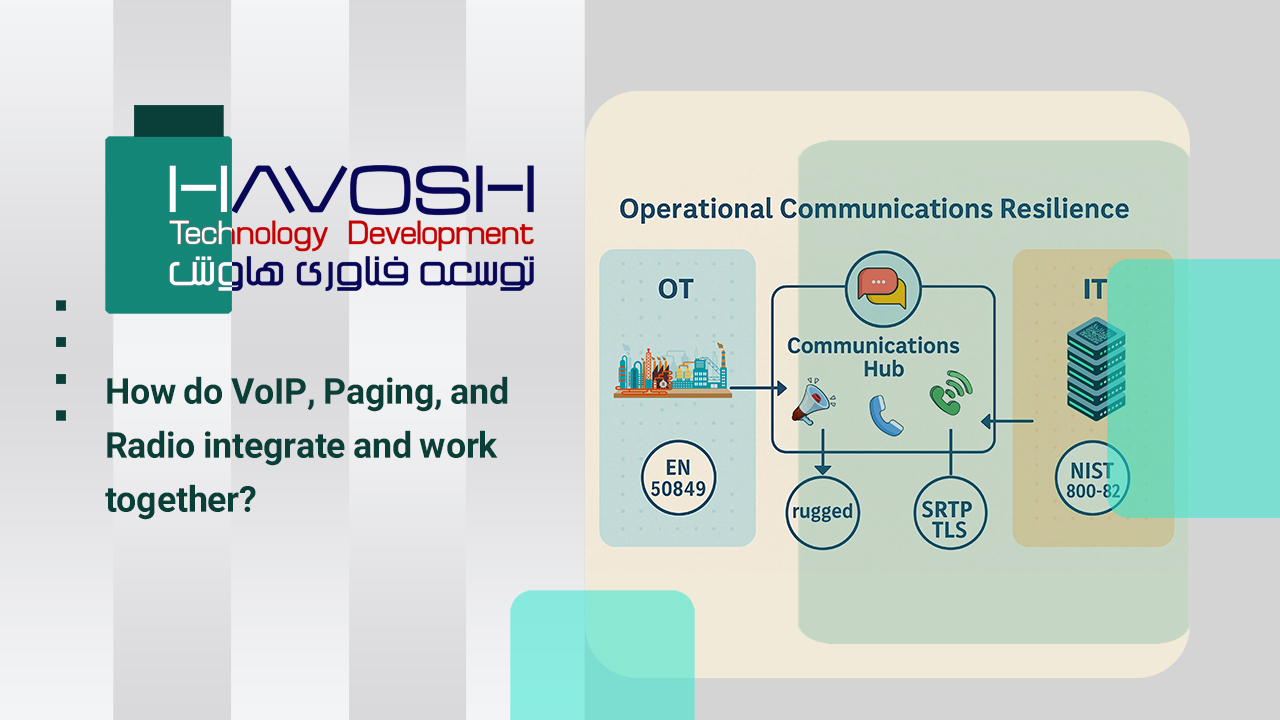
How do VoIP, Paging, and Radio integrate and work together?

In high-risk petrochemical environments, the quality and continuity of operational communications are critical. This article provides a practical framework for designing a “secure, resilient, and integrated” communications network that brings together VoIP, Public Address and Alarm (PAGA) and radio (based on recognized industry standards) under a coherent strategy.

This article demonstrates how quality assessment can be elevated from the level of “ Secure and Resilient Communication Architecture in the Petrochemical Industry ".

  1. Intelligent OT/IT Separation (Start with Zones and Conduits)

The ZONES & CONDUITS pattern in IEC 62443 provides a systematic way to separate process control networks from IT, define security levels, and control traffic flow. This reduces the risk of incident contagion and makes the availability of critical voice services manageable.

Practical Tip: Separate operational VoIP subsystems (shift calls, paging, intercom) into “communication services zones” and establish access between zones only through “controlled conduits.” NIST SP 800-82 recommends the same separation of layers and controlled ports for ICS.

2. Guaranteed Call Quality

For uninterrupted communication in operational conditions, one-way delay ≤ 150 MS and low JITTER are required. On the network side, define EF class (DSCP=46) for VoIP media and CS5 for signaling, and apply them on routers to control priority queuing, policing, and CAC congestion.

Network Checkpoints:

  • Enable END-to-END QOS (ACCESS / DISTRIBUTION / CORE/ WAN)
  • Separate voice VLAN from data + TRUST BONDARY at the switch edge
  • Monitor KPIs: MOS, PACKET LOSS, JITTER, ONE-WAY DELAY

3. Redundancy and Service Continuity across Multiple Sites

For multi-site clusters, MPLS/SD WAN routes with intelligent FAILOVER policies and HYBRID SIP/E1 for long outages of external links reduce the risk of sudden outage of operational communications. Addressing scheme and SRTP/TLS (if required) should be accompanied by END TO END monitoring chain that quality KPIs can be seen online.

Recommended pattern:

  • Main SIP TRUNK over Secure WAN plus BACKUP over MPLS/4G
  • Local Survivability for critical sites (GATEWAY with DSP and local ROUTE)
  • Emergency routing for highest priority HSE and PAGA calls

4. Emergency Integration with PAGA (PAGING SYSTEM)

PAGA systems should be designed according to EN 50849 (Emergency Voice Systems); this means specific performance, audio coverage and testability requirements. VoIP integration with PAGA via SIP/MULTICAST or dedicated ports should be FAIL SAFE and alarm priority should be maintained over all other traffic.

5. Security in action

In addition to the zone/conduct architecture, role-based access policies (RBAC), event logging, IDS/IPS, and continuous traffic monitoring are essential. Adhere to the principle of least access, patch management, and separation of system CREDENTIAL. Consider hardening defaults and NON-DEFAULT PORTS for field equipment (radio/gateway/IP phone).

6. Why Now? Direct Impact on Operations

  • Risk Reduction: Reliable Notifications and Clear Calls in Emergency Situations.
  • Operational Improvement: Consistent, Quality Calls in Production Shifts.
  • Cyber ​​Resilience: Reduced Attack Surface Area and Incident Contagion with IEC 62443/NIST 800 82

Havosh 90-Day Toolkit

  1. Rapid assessment of operational communication network SEGMENTATION, QOS and backup paths
  2. Implementation of EF/DSCP 46 policy and monitoring of VoIP KPIs
  3. PAGA integrity review and periodic testing according to EN 50849
  4. Documentation of “Zones and Conducts” according to IEC 62443 and access hardening.
  5. Real-time call quality monitoring plan Management DASHBOARD and alert system

About Havosh:

Havsh designs and implements operational communications architecture for process industries, focusing on VoIP, UNIIFIED COMMUNICATIONS and CONTACT CENTER (based on AVAYA solutions).

From OT/IT separation and QOS to PAGA INTEGRATION.

Contact center solutions with real-time recording and reporting in multi-site projects, backup routing design and LOCAL SURVIVABILITY are our specialties.